Module 1
Introduction to Parent Management Training
Welcome to BE HAPPY, we are glad you are here! Kids do not come with manuals, and many parents struggle to manage childhood behaviors. You are not alone! The goal of this program is to improve your relationship with your child by increasing positive interactions, decreasing problem behaviors, and improving effective discipline. The strategies you will learn about are called Parent Management Training (PMT). PMT is evidence based, which means it has been researched and shown to help with difficult childhood behaviors like tantrums, aggression, not listening, and more. Parenting is stressful and BE HAPPY aims to reduce stress to improve positivity for your whole family!
How to get the most out of BE HAPPY
- Engage with the modules: We encourage you to set aside time each week to read through the information, watch the videos, and reflect on how the techniques can be helpful for your family.
- Practice makes progress: At the end of each module, we will provide action steps to try at home. To get the most out of this program, practicing at home is vitally important. Just like you would practice a new sport or instrument, we ask that you try out the skills as much as possible.
- Be consistent: It will take time for your child to adjust to new boundaries and new discipline strategies. We encourage you to stick with the skills consistently; don’t give up when it feels challenging!
- Give yourself grace: We recognize that it is hard to learn and implement new skills on top of already busy lives.
What is Parent Management Training (PMT)?
Parent Management Training or PMT is an evidence-based set of skills designed to help children overcome behavioral challenges and to build stronger family relationships. Below we will discuss the core of what PMT is:
- Skills-Based: PMT is not about putting the blame on parents or children, but instead views parenting as a set of skills to learn and refine. It is like a bee learning which flowers have the best nectar. At first, they explore and try different flowers. Eventually they learn which flowers work the best and they get better at gathering the nectar to make honey.
- Proactive: The goal is to create an environment at home that encourages good behavior. This is done through positive attention and direct expectations. In turn, this reduces the need for constant correction.
- Collaborative: This approach is adaptable to meet you where you are. You are the expert on your child. PMT provides the tools, and you will learn how and when to apply them to fit with the unique needs of your family.
Who is it for?
Parent Management Training is designed to be helpful for anyone who interacts with children. Parents, grandparents, foster care families, and any guardian can benefit from learning these skills. We will use the term “parents” in our modules, but we want all caregivers to be included!
Why is it Helpful?
PMT was developed by child psychologists in the 1960s and has since been improved by research over the last 50 years to what it is today. It is one of the most effective treatments for children with disruptive behaviors such as defiance and aggression. It works because it adjusts the interaction between you and your child. It focuses on reinforcing positive behaviors to reduce problems, build self-esteem, and improve your relationship.
Now that you have a better understanding of what PMT is, let’s get started! In the first module, we will explore some of the reasons why children misbehave.
What influences behavior?
There are many things in a child’s life that can influence both positive and negative behaviors.
- Temperament: Every child comes preequipped with their own unique personality and temperament. Some children are active and outgoing and others are quiet or shy. Some have big emotions and responses and others are more steady. Some can stay focused on one thing for a long time while others need constant stimulation. Some adjust easily to changes and others need a lot of help coping with change. There is no good or bad temperament. Rather, we tend to see problem behaviors when a child’s temperament does not match with their parents' temperaments, environmental demands, or what’s happening at the moment. For example, some children may thrive in a busy classroom because they are outgoing and like stimulation. A more introverted child may struggle to make friends and follow directions because they feel overwhelmed.
- Big life changes: Big changes can cause some children to behave differently, even when the change is positive. This may include moving, bringing home a new baby, parents changing jobs, starting school, or losing a loved one. Some children may keep their feelings inside and become sad and withdrawn, while others show their emotions on the outside through tantrums and defiant behaviors. Other children may regress such as starting old behaviors like wetting the bed, biting, or using baby talk.
- Traumatic experiences: Parents do everything they can to keep their children safe, but sometimes scary things still happen. Traumatic events like natural disasters, car accidents, medical emergencies, abuse, and neglect can have significant effects on childhood behavior. Much like with big life changes, children may keep their emotions inside, show emotions on the outside, and regress in behavior.
Understanding Functional Behavior
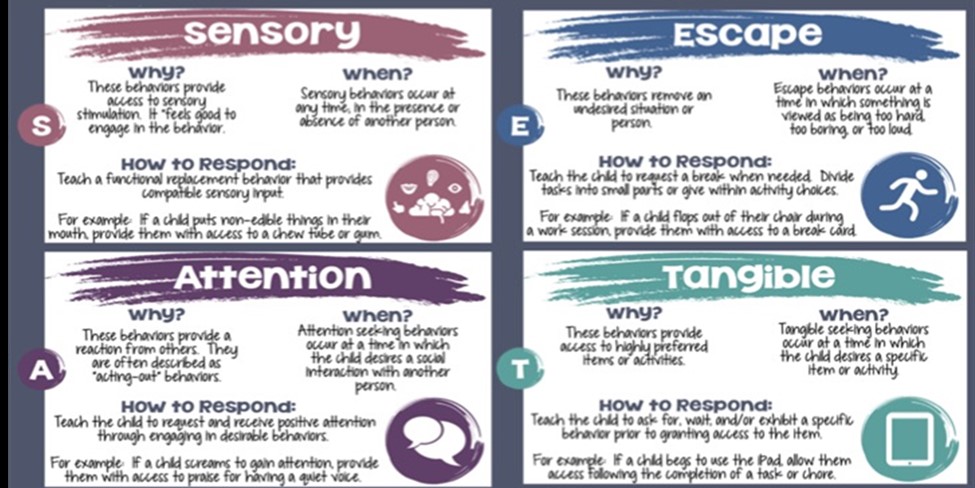
All behaviors serve a purpose or “function” for your child, even the ones that feel the most challenging. Some reasons why a child may behave in a certain way include:
- To Get Attention: Children will seek out attention in any way they can. Even negative attention, such as being scolded, is better than no attention.
- To Get Something: This could be an object such as a toy, snack, or game. It could also be something like an activity such as going outside or playing with friends. Children will communicate what they want through their behavior.
- To Avoid: Children like to avoid things they dislike. A child might have a meltdown to get out of doing homework, chores, or going to bed.
- To Manage Needs: In some cases, a behavior may help a child cope with being over or under stimulated. When overstimulated children may rock, run away, cover their ears, or refuse to participate. When under stimulated children may jump, run, climb, fidget, and talk excessively.
Children will often act out because they have learned that, by behaving in a certain way, they are able to get their needs met. They are not trying to be “bad” but instead are using the way they have learned to communicate. When you give attention to these negative behaviors, it tells kids they should continue the behavior. In other words, paying attention to negative behavior reinforces it and causes it to increase. It is like watering a weed; the more you water it, the more it grows.
The key to changing challenging behavior is to first understand why it is happening in the first place. Once you know the function you can teach your child a better way to achieve the same goal.
The ABC’s of Behavior
One of the most straightforward and powerful tools for understanding the function of behavior is the ABC chart. ABC stands for Activating Event, Behavior, and Conclusion.
- Activating Event: This focuses on what happened right before the behavior and what triggered the behavior. Think about where you were, what was said, and what was happening.
- Behavior: What was the specific behavior that your child did? It is important to note that this should be a concrete description and not your interpretation. For instance, instead of saying your child threw a tantrum, you would say that they yelled and threw the toy. Describe the behavior like you are a sportscaster!
- Conclusion: Focus on what happened right after the behavior. How did you respond? Was there something that your child gained or avoided?
Why Use the ABC Chart?
By using this method, you can slow down and process what happened in a detailed and informed way. It is like watching bees in a garden. You notice which flowers they visited (activating event), what they do at each flower (behavior), and what they get from it such as pollen (conclusion). Much like watching the bee, tracking this in your child can help you understand why the behavior happened. Filling out an ABC chart for a problem behavior does two critical things:
- It can help identify and spot patterns of the triggers causing the behavior.
- It can show you what your child is getting out of the behavior.
The ABC’s in Action
Now we will look at an example of an ABC chart to see how they work in real situations. Seeing these examples can help make the process clearer and show how ABC charts can be a guide in understanding challenging behaviors.
| Date/Time/Place | Activating Event | Behavior | Conclusion |
| August 26 at 10am in the living room. | Asked to clean up toys | Child yelled “No!” and threw all of the toys on the floor. | I scolded them. |
| August 26 at 1pm in the kitchen. | Said snack time is over | Child screamed and cried | I gave the snack. |
| August 26 at 6pm at the grocery store. | Younger sibling was getting attention. | Child hit the sibling. |
I removed the sibling and gave attention to the child. |
When we take a look at the behaviors included on the ABC chart, we notice that the child yelled and threw their toys to avoid cleaning up, screamed and cried to get a snack, and hit their sibling to get attention. This knowledge can help parents better respond the next time such situations arise. For example, the parents can turn cleaning up into a game or ensure both children are getting attention.
Handouts:
Module 1 Action Steps:
-
-
- Reflect: Think about one of the most common challenging behaviors your child has.
- Download: Print out or download a copy of the ABC Chart for your use.
- Practice Makes Progress: Fill out the ABC chart for that behavior at least 2 times this week to see if you can spot any patterns.
- Self-Compassion: This is a learning process. Remember this is meant to help you identify patterns and not to grade your parenting.
-
In the next module, we will start building a set of skills to encourage building a stronger connection.