Module 4
Increasing Positive Behaviors
Welcome to Module 4! In this module, we will be learning ways to create a positive environment and to increase behaviors that you want to see. The general rule is that any behavior that is rewarded will increase. It is important to remember that for kids, any attention is rewarding, even negative attention. It’s easy to fall into the habit of scolding or correcting your child when they are doing something unhelpful and failing to notice neutral and helpful behaviors. When we get into this habit, unhelpful behaviors are rewarded with attention, and we see such behaviors increase. The goal is to flip the script and reward helpful behaviors that you want to see increase.
Rewards can take many forms, including verbal praise, earning privileges, and physical rewards. We encourage you to try out different forms of rewards to figure out what works best for your family!
Catch Your Child Being Good
As a parent, your job is to catch your child being good and to point it out! This can be difficult if your child’s unhelpful behaviors are getting all your attention. You may need to think about opposite behaviors that you would like to reward. For example, if your child is constantly running around, you can point out when they are sitting in their chair.
Verbal praise is often the best reward. It communicates clearly to your child that you are paying attention to their behavior and noticing their efforts. In order to be most effective, we want to use “specific labeled praise.” Specific labeled praise lets your child know exactly what they did that you liked. Rather than saying “good job,” you could say “good job putting on your shoes the first time I asked.” We use specific labeled praise with children because:
- It causes helpful behaviors to increase
- It lets your child know clearly what the helpful behavior is
- It increases your child’s self-esteem
- It adds positivity to the parent-child relationship
- It makes you and your child feel good!
Specific labeled praise can sound like:
- I love how you are using your inside voice!
- Thank you for putting your dishes in the sink.
- I like how you are playing gently with your brother.
- You are doing a great job holding my hand in the store.
Remember, specific labeled praise should be immediate and genuine!
Reward Charts
As children are building new behaviors and habits, it can be helpful to motivate them with physical rewards in addition to specific labeled praise. Creating a rewards chart lets kids know what they are working on, what rewards they will receive, and how they are progressing. Just like many adults enjoy checking things off their to-do lists, kids love being recognized for their accomplishments!
While any behavior can be rewarded, we want to be thoughtful about what behaviors are making it onto the rewards chart. Some helpful tips include:
- Behaviors should be developmentally appropriate: For example, if your child is too young to unload the dishwasher, select a simpler behavior like putting the silverware away.
- Make behaviors very clear: Young children may not understand exactly what “clean your room” means. More specific behaviors include making your bed or putting your clothes away.
- Build up to behaviors: In order to ensure your child is successful, work up to more complex behaviors. If the end goal is to get ready for school, smaller goals could be brushing your teeth and putting on your shoes.
- Pick a reasonable number: Select 2 to 3 behaviors to start out with. Parents may choose to stay at this number and make behaviors more challenging with time; you may increase from making your bed 2 times each week to making your bed every day. Other parents may choose to increase the number of behaviors. However, too many behaviors on a rewards chart gets confusing and difficult to keep up with so limit the number to 8!
Parents should also think carefully about what rewards they want to offer. Rewards should be motivating for your child and sustainable over time. Effective rewards can include:
- Privileges: Children can earn many everyday things, like dessert, screen time, extracurriculars, and toys. Make sure to pick something that motivates your child!
- Experiences: Children can earn fun experiences, like going to the park, staying up 15 minutes later, watching a movie with parents, or getting ice cream.
- Choices: Children love making choices, so they can earn that option! They can choose things like what show to watch, what game to play, or what to have for dinner.
- Physical rewards: Some parents do choose to offer physical rewards, like money or toys. This is completely fine as long as the reward is feasible and sustainable. For example, it may be sustainable to offer $1 if your child studies for 30 minutes each school night. However, it may not be sustainable to buy a new video game every time your child takes a shower!
Rewards should be timely, depending on your child’s age. Younger children benefit from immediate rewards like stickers or special snacks. As children get older, they can move to daily rewards and eventually weekly rewards.
Let’s take a look at a sample rewards chart!
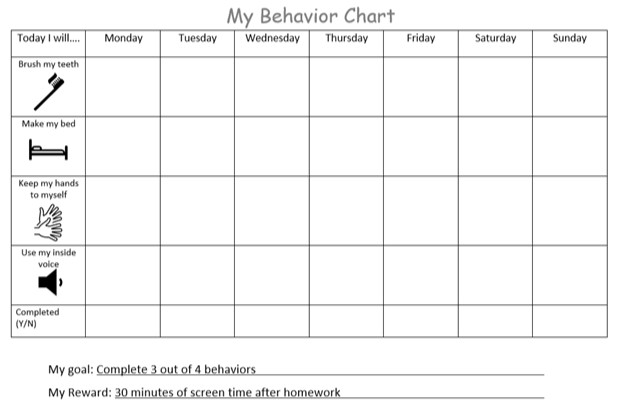
A few things to notice:
- Behaviors are clear and concise
- Visual cues are provided to help a younger child remember what to do
- The goal is clear and attainable
- The reward is sustainable and can be earned daily
A blank reward chart is included below for you to try out. Have fun with your reward chart! Pick a template that fits your child’s interests, add visuals, and post it somewhere central in the house like the kitchen. Remember, what we reward increases. The more consistent you are and the more rewards your child can earn, the more they will want to engage in helpful behaviors!
Creating a Positive Environment
We’ve learned that rewards and praise are highly effective ways to increase helpful behaviors. Parents can intentionally set up the environment in a way that gives your child more opportunities to make good choices and gives you even more opportunities to offer praise and rewards! Try out the following ideas to create a more positive environment in your home:
- Problem solve ahead of time: Are there certain things that always trip your child up? Perhaps they always play with the remote or color on inappropriate things. Problem solving ahead of time can look like putting tempting objects away, providing appropriate choices, changing the order of activities, and so on. For example, if your child struggles to not eat dessert before dinner, consider putting the sweet snacks out of reach. If your child has a hard time turning off video games when it is time to do homework, consider saving screen time until after homework is done. Spend some time thinking about common misbehaviors to see if there are simple solutions that can increase good choices!
- Offer choices: Kids love to have autonomy and to feel like they are involved in decision making. They are more likely to comply with directions when they get a say, so it is helpful to offer choices whenever possible. Offer two choices that you are comfortable with and let them choose! You can offer broccoli or green beans with dinner, allow them to choose the red or blue shirt, or have them decide if they would like to bathe before or after dinner.
- Use if/then and when/then statements: It is helpful to make rules and rewards very clear from the beginning. If/then and when/then statements allow parents to clearly communicate what is expected from their child and what rewards they can expect when they comply. A parent may say, “If you pick up your toys, then we can go outside to play” or “when you use your indoor voice, then I will talk with you.”
Handouts:
Creating a Positive Environment
Module 4 Action Steps:
- Practice it: Take 15 minutes each day to pay close attention to your child’s behavior and praise any helpful behaviors that you see. Make a big deal when your child makes good choices!
- Make it: Download the reward chart template and select 2 to 3 behaviors and 1 reward to implement this week.
- Reflect: What behaviors do you correct with your child most frequently? How can you use praise, rewards, and positive environment strategies to encourage more helpful behaviors?
- Self-Compassion: It takes a lot of energy to catch your child being good, to reward, and to create a positive environment. Give yourself some praise and compliments for your efforts, you are making strides towards a better parent-child relationship!