Hibbs Brief May 2026
Access to Capital in East Texas: How SBA Lending Supports Small Business
By Manuel Reyes, D.E.D. and Cecilia Cuellar, Ph.D.
Small businesses — including new ventures and startups — are a cornerstone of the East Texas economy, and access to capital often determines whether they can launch, expand, invest or adapt during challenging periods. This edition of the Hibbs Brief examines how the U.S. Small Business Administration (SBA) supports small business financing in East Texas. It reviews national lending trends, identifies local institutions providing SBA backed loans and explores the industries making the greatest use of this financing. The discussion is descriptive, highlighting where SBA lending is most active across the region and where opportunities to expand access remain.
SBA Lending: Bridging the Capital Gap
Created in 1953, the SBA was established to help small businesses navigate barriers to growth.1 Among the most persistent of these barriers is access to capital, particularly for startups and firms with limited collateral, shorter credit histories or other features that can complicate conventional lending.
Rather than lending directly, the SBA guarantees a portion of loans issued by partner banks and approved lenders. The guarantee is typically associated with more favorable terms for borrowers, including lower down payments and longer repayment periods.
The two principal programs are 7(a) and 504. The 7(a) program is the SBA’s most widely used lending tool, providing flexible financing for working capital, real estate, debt refinancing and equipment purchases. The 504 program supports larger fixed-asset investments, such as commercial real estate or major equipment and is typically used by firms pursuing long-term expansion.2
Figure 1 presents national SBA lending from FY 2014 to FY 2025, combining 7(a) and 504 loan counts with inflation-adjusted gross approvals. The 7(a) program accounted for roughly 92% of loans during this period, highlighting its central role in small business financing. Activity remained relatively steady through the mid-2010s before declining in FY 2019 and FY 2020, as the COVID-19 pandemic shifted attention toward emergency relief programs such as the Paycheck Protection Program (PPP) and Economic Injury Disaster Loans (EIDL).3 Lending rebounded in FY 2021 and, after a brief pullback, increased again through FY 2024 and FY 2025. This national pattern provides useful context for the East Texas discussion that follows.
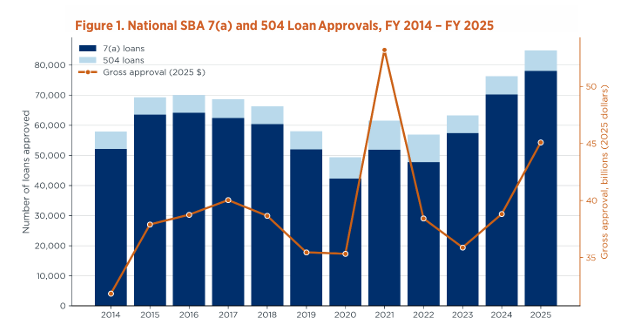
Source: The Hibbs Institute estimates using U.S. Small Business Administration FOIA 7(a) and 504 data as of 12/31/2025. Gross approval converted to 2025 dollars using BLS CPI-U.
SBA Lending in East Texas: Who Is Lending?
In FY 2025, more than 60 financial institutions extended SBA 7(a) loans to small businesses across East Texas (23 counties).4 The lender base included a mix of local and regional banks, national institutions and specialized nonbank SBA lenders, collectively reaching firms across a wide range of industries and communities.
This mix shapes how firms connect to capital. Community based lenders often bring local knowledge and longstanding relationships, while national banks and non-bank specialists contribute broader geographic networks and deeper SBA program expertise, expanding the range of financing pathways available across the region.
Figure 2 highlights the most active institutions in East Texas SBA lending in FY 2025. Panel (A) presents the 10 7(a) lenders with the highest loan counts, which together accounted for roughly 48% of the region’s 7(a) activity.
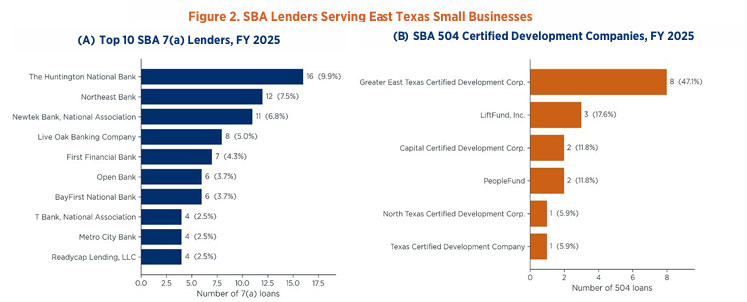
Source: The Hibbs Institute estimates using U.S. Small Business Administration FOIA 7(a) and 504 data as of 12/31/2025. East Texas = 23 counties. FY 2025 loans: 161 7(a); 17 504 7(a) uses direct lenders (banks/SBLCs); 504 uses CDCs as the SBA intermediary.
The Huntington National Bank led the group, followed by Northeast Bank and Newtek Bank. Average loan sizes varied considerably across these lenders, reflecting a range of business models rather than a single approach to SBA lending.
Panel (B) shows the Certified Development Companies (CDCs) that intermediated the region’s 504 loans. Activity on this side was far more concentrated than in the 7(a) program, with Greater East Texas Certified Development Corporation originating close to half of the region’s 504 loans and a small number of other CDCs accounting for the remainder.
Taken together, East Texas exhibits a diverse lender base on the 7(a) side and a more concentrated structure on the 504 side. The latter pattern may point to uneven access across counties and borrower types, particularly in rural communities where CDC presence is limited. Expanding CDC participation could help strengthen access in those areas.
SBA Lending in East Texas: Who Is Borrowing?
SBA-backed loans support businesses across a wide range of industries in East Texas, where small firms are closely tied to local employment, services and community life. Figure 3 presents the industry distribution of SBA-backed loans in FY 2025, classified by NAICS sector.
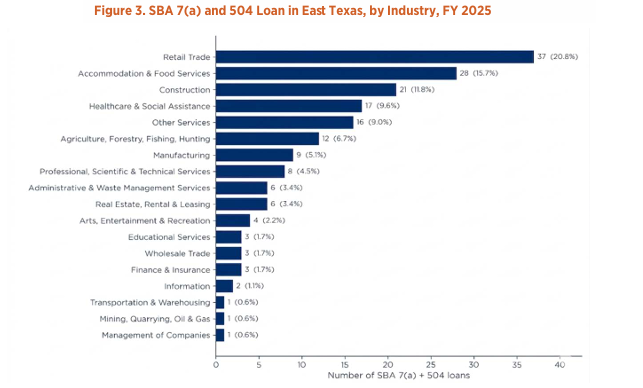
Source: The Hibbs Institute estimates using U.S. Small Business Administration FOIA 7(a) and 504 data as of 12/31/2025. East Texas = 23 counties. Industries classified by NAICS 2-digit sector. Total loans: 178.
Roughly two-thirds of SBA loan activity was concentrated in five sectors. The Retail Trade sector recorded the highest number of loans, followed by Accommodation and Food Services, Construction, Healthcare and Social Assistance and Other Services sectors. By dollar volume, however, the Accommodation and Food Services sector ranked first, indicating larger average loan sizes in that sector.
These patterns align with the structure of the East Texas economy. Retail and food services are consumer-facing industries tied to household demand while construction reflects ongoing building activity across the region. Healthcare and other local services round out a mix of growth-oriented and community-serving industry sectors drawing on SBA-backed financing.
The remaining activity was distributed across more than a dozen additional industries, suggesting that SBA lending in East Texas reaches a relatively broad business base rather than a narrow segment of the regional economy.
Why SBA Lending Matters in East Texas
For small businesses in East Texas, access to capital can shape whether a firm is positioned to expand, invest or remain resilient during periods of uncertainty. The patterns in this brief suggest that SBA-backed lending has an established presence in the region, reaching a diverse set of industries through a network of lenders and CDCs.
Two observations stand out. First, SBA-backed capital is reaching sectors central to the regional economy, including retail, food services, construction, healthcare and other local services. Second, activity remains concentrated among a relatively small group of institutions, suggesting that access may still depend on lender presence, program expertise and borrower awareness.
Taken together, these patterns position SBA lending as an integral component of the region’s broader business support infrastructure. Expanding awareness of available programs and encouraging participation from additional lenders and CDCs could help strengthen access to capital, particularly in rural and underserved parts of East Texas.
Acknowledgments
Special thanks to Maria Rodriguez, student research fellow (summer 2025) , for her valuable contributions to the first draft of this edition of the Hibbs Brief.
End Notes
1U.S. Small Business Administration. (n.d.). About SBA – Organization. Retrieved from
https://www.sba.gov/about-sba/organization
2U.S. Small Business Administration. Funding Programs – Loans. https://www.sba.gov/funding-programs/loans
3U.S. Small Business Administration. COVID-19 Relief Options. https://www.sba.gov/funding-programs/loans/covid-19-relief-options
4For the purpose of this analysis, the Hibbs Institute defines East Texas as the 23
counties within its service area: Anderson, Bowie, Camp, Cass, Cherokee, Delta, Franklin,
Gregg, Harrison, Henderson, Hopkins, Lamar, Marion, Morris, Panola, Rains, Red River,
Rusk, Smith, Titus, Upshur, Van Zandt and Wood.