America 250: Celebrating America's Economic System of Freedom - Opportunity, Achievement and Innovation
View PDF Version
From the Founding Principles to the Enterprising Spirit of East Texas

By: Marilyn Young, Ph.D.
Professor of Management
Hibbs Faculty Research Fellow
As America approaches its 250th anniversary of the signing of the Declaration of Independence, we should ask an important question:
How did a nation so young rise to such extraordinary levels of prosperity?
 While many civilizations have existed for thousands of years, the United States, in
just two and a half centuries, has achieved one of the highest standards of living
in human history. The nation has generated remarkable levels of economic output and
personal income in a short time. Our gross domestic product exceeds $30 trillion,
and per capita income ranks among the highest in the world.1,2
While many civilizations have existed for thousands of years, the United States, in
just two and a half centuries, has achieved one of the highest standards of living
in human history. The nation has generated remarkable levels of economic output and
personal income in a short time. Our gross domestic product exceeds $30 trillion,
and per capita income ranks among the highest in the world.1,2
A major reason for this achievement is our economic system of freedom, including private property, open markets and the freedom to pursue opportunities. Other factors that supported America’s economic growth were natural resources, financial institutions, cultural influences and religious traditions that emphasized hard work, thrift and responsibility, and encouraged entrepreneurship and economic progress. For 250 years, the freedoms that sustain America’s economy have been protected by the nation’s military and government institutions.3
The Foundation of America’s Economic System
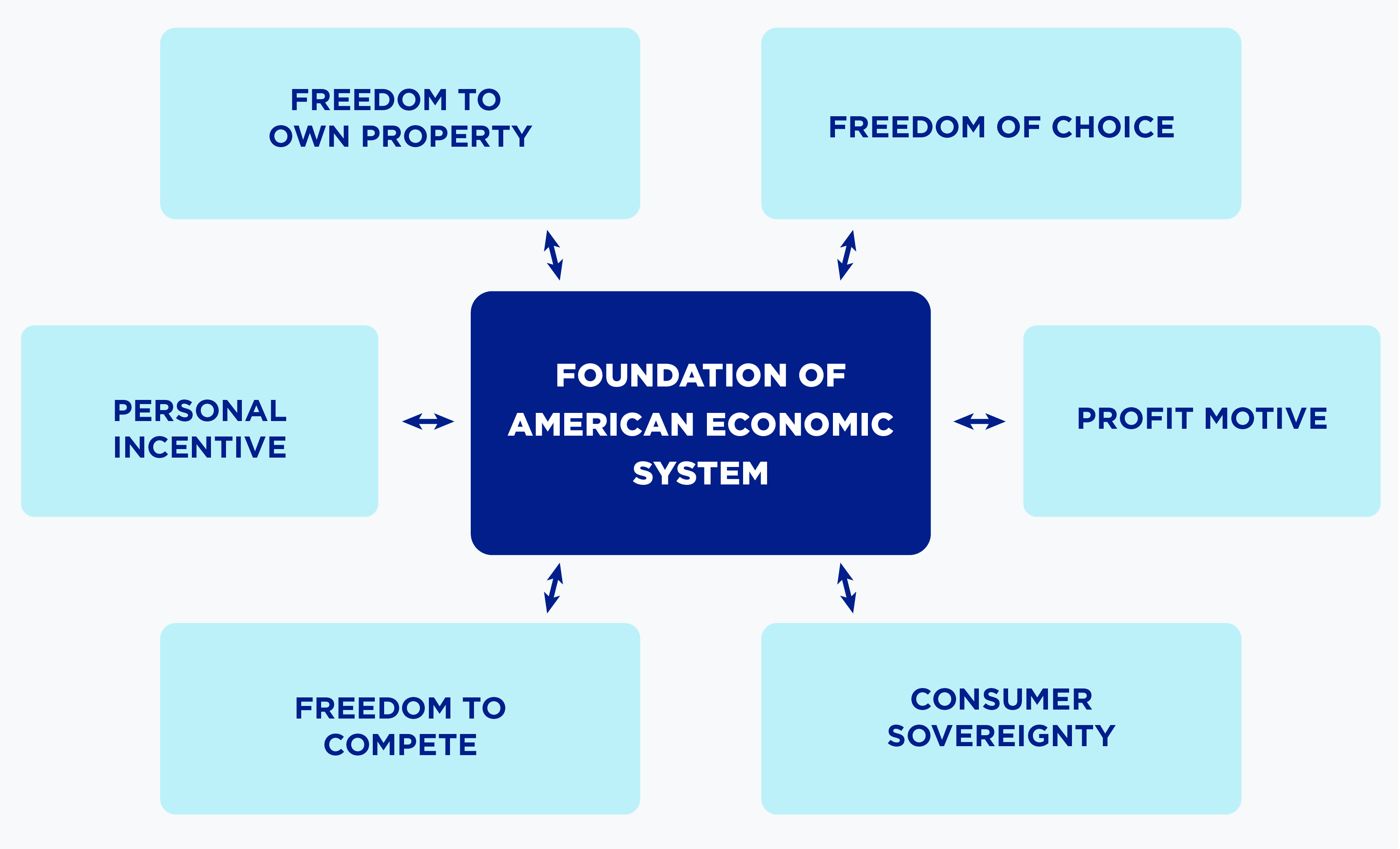
The American economic system is built on the belief that individuals make decisions about work, consumption, investment and innovation. While laws and regulations exist to promote fairness, safety and stability, much of economic activity is driven by competition and personal choice. These principles have helped encourage entrepreneurship, technological progress, rising living standards and an economy that adapts to changing conditions.
A central principle is freedom of choice, in which individuals are free to decide what careers they want to pursue and what goods and services they want to purchase. Workers can select jobs that match their interests and skills, while consumers choose the products that best meet their needs. These choices influence how resources are used and what businesses decide to produce.
Another important concept is the profit motive. Businesses aim to earn profits, which encourages them to identify consumer needs and develop products or services that people value. The possibility of profit also encourages firms to operate efficiently and find better ways to produce goods.
The system also includes the freedom to own property. Individuals and businesses can acquire and control resources such as land, buildings, equipment and ideas. Ownership gives people the authority to decide how those resources are used, invested or exchanged in the marketplace.
Closely connected is personal incentive. People are motivated to work hard, develop new skills and take risks because they can benefit from their efforts. This motivation encourages productivity, entrepreneurship and economic growth. Another key feature is freedom to compete. Businesses compete to attract customers, which encourages innovation, efficiency and improved quality of goods and services.
Finally, consumer sovereignty means that consumers play a major role in shaping the economy. Through their purchasing decisions, consumers influence which goods and services are produced. Businesses respond to these choices by adjusting what they offer in the marketplace. Together, these freedoms form the foundation of America’s economic system.4, 5, 9
Economic Development and Transformation
Adam Smith (1776) described this system as the “invisible hand,” where individuals, while pursuing opportunity and self-interest, unintentionally contribute to broader economic prosperity and often advance the prosperity of society as a whole.9 Later, David McClelland emphasized the role of the “need for achievement,” suggesting that individuals are motivated to achieve, improve and become entrepreneurs and innovators. Survival, rebuilding and ingenuity were essential stages in our growth and prosperity.
Survival: Families cleared land, built shelters, established trade and took risks in uncertain conditions. Property rights, personal responsibility and voluntary exchange became essential features of the emerging economy.
Rebuilding: Major events required the nation to reconstruct institutions, infrastructure and markets while expanding opportunity.
Ingenuity and Entrepreneurship: Incentives that allowed individuals the opportunity to work, innovate and develop new concepts. McClelland’s concept of the “need for achievement”7 helps explain why many individuals pursued opportunities, became innovators and improved their crafts and way of life.
Economic development progressed through five stages: traditional society, preconditions for takeoff, takeoff, the drive to maturity and the age of high mass consumption.6 Over time, these stages evolved into broader phases of development. The Industrial Revolution introduced large-scale manufacturing and transportation networks. The 20th century expanded mass production, consumer markets and global trade. Now, the Information and Digital Age is driven by knowledge, technology and innovation.3, 8
East Texas and the American Spirit
The 1930 discovery of the East Texas Oil Field near Kilgore created one of the largest
oil booms in our history, and East Texas became a center of energy production and
entrepreneurial opportunity. 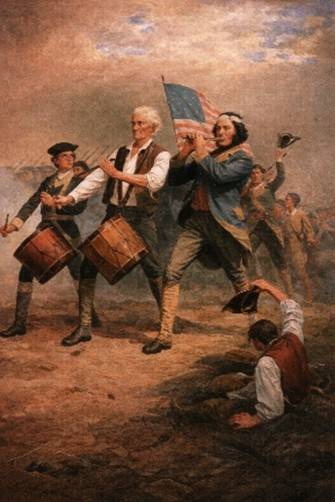
Freedom of choice is evident in East Texas small businesses, educational institutions and entrepreneurial ventures that respond directly to consumers. America’s economic system has enabled generations of individuals to pursue opportunity and succeed.
Table 1 shows just a few examples:
Table 1
Examples of East Texas Entrepreneurial Successes
| Sector | Example |
|---|---|
| Grocer | In 1928, a small 2,500-square-foot grocery store on the Tyler courthouse square with four employees grew to a major region chain of over 200 stores. |
| Insurance | An insurance salesman with three employees built one of the Southwest's largest risk-management firms. |
| Banking | A Jacksonville banker opened a small bank in Frankston, and now over 125 years, the family-owned community bank has 39 locations serving East and Southeast Texas. |
| Food processing | A young entrepreneur, after years of experimentation, created distinctive fajita flavors that grew into a nationally recognized success. |
| Bootmaker | A small boot shop, built on quality and service, grew into a nationally recognized brand with more than 100 stores in multiple states. |
| Energy | A small oil company grew into one of the largest privately held energy companies in the United States. |
| Real Estate | Since 1878, the family business has shaped the landscape of Tyler. This legacy includes developing the historic Azalea District and donating land for a park. |
| Healthcare | What began as one doctor's vision has expanded into a multi-location practice known for comprehensive eye care, advanced cataract surgery and LASIK laser surgery, now with a large modern clinic. |
The spirit of opportunity in East Texas has produced achievements not only in business but also in other areas. It is exciting to see the success of many East Texans who believed, through perseverance, achievement and creativity — and a strong sense of self-efficacy — that they could succeed. Table 2 shows a few examples.
Table 2
Examples of Individual Achievement in East Texas
| Field | Example |
|---|---|
| Broadway Performer | A young dancer from New London and later Tyler became Peter Pan on Broadway. |
| Concert Pianist | A pianist from Kilgore achieved international recognition after winning the Tchaikovsky Competition in Moscow. |
| Academy Award Winner | A young woman from Quitman won an Academy Award for her role as Loretta Lynn in "Coal Miner's Daughter." |
| Songwriter | A renowned songwriter composed "My Heart Will Go On," the theme from "Titanic." |
| Journalist | A Tyler Junior College graduate became a White House reporter who interviewed 11 U.S. presidents. |
| Engineering Innovator | An innovative engineer who later made Longview his home pioneered earth-moving equipment used around the world and founded a university dedicated to engineering and technological innovation. |
Freedom comes from initiative and achievement and produces extraordinary outcomes. The need for achievement7 is a powerful social motive, encouraging individuals through effort and initiative to strive to become their best. The Spirit of ’76 above reminds us of courage, perseverance, resilience and sacrifice — leading to innovation and enterprise. The future of American prosperity will be driven by its past through new innovators, builders and leaders. The Spirit of ’76 continues as individuals pursue opportunities and believe that the future can be better than the past.
As Theodore Roosevelt observed, “Believe you can, and you're halfway there,” a sentiment that reflects the spirit of initiative and opportunity that continues to shape American success.
Art (Paintings):
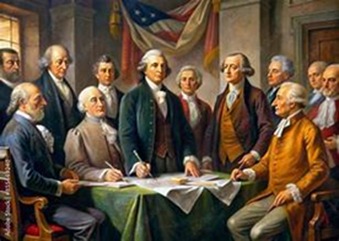
John Trumbull, Declaration of Independence, 1819. U.S. Capitol Rotunda.
Archibald M. Willard, The Spirit of ’76, 1876.
Business Examples:
Brookshire Grocery Company, Hibbs-Hallmark Insurance (Heartland Security), Austin
Bank, Cavender’s Boot City, Hunt Oil Company,
Bergfeld Realty Co. and Heaton Eye Associates.
Individual Examples:
Sandy Duncan, Van Cliburn, Sissy Spacek, Will Jennings, Sarah McClendon and R. G.
LeTourneau.
1 U.S. Bureau of Economic Analysis. Gross Domestic Product, 2023 (current dollars). U.S. Department of Commerce, 2024.
https://www.bea.gov/data/gdp/gross-domestic-product
https://www.bea.gov/data/income-saving/personal-income
9 Smith, Adam. An Inquiry into the Nature and Causes of the Wealth of Nations. London: W. Strahan and T. Cadell, 1776.
The Hibbs Institute has created a LinkedIn page that frequently releases business and economic information.
Follow our page for future brief updates, announcements and links to our periodic publications.