Hibbs Outlook of East Texas
Manuel Reyes, D.E.D., Cecilia Cuellar, Ph.D., and Sara Maldonado
Rising childcare costs are straining family budgets at a time when wages are not keeping
pace, leaving many households with less money available to cover basic needs like
housing and transportation.1 According to the Economic Policy Institute, the annual cost of caring for one infant
now exceeds average rent in 17 states, making childcare one of the largest household
expenses outside of housing. Additionally, the cost of infant care is higher than
in-state public college tuition in 38 states, showing that families often pay more
to look after a baby than to send a young adult to a local university.2
Childcare expenses have surged above overall inflation
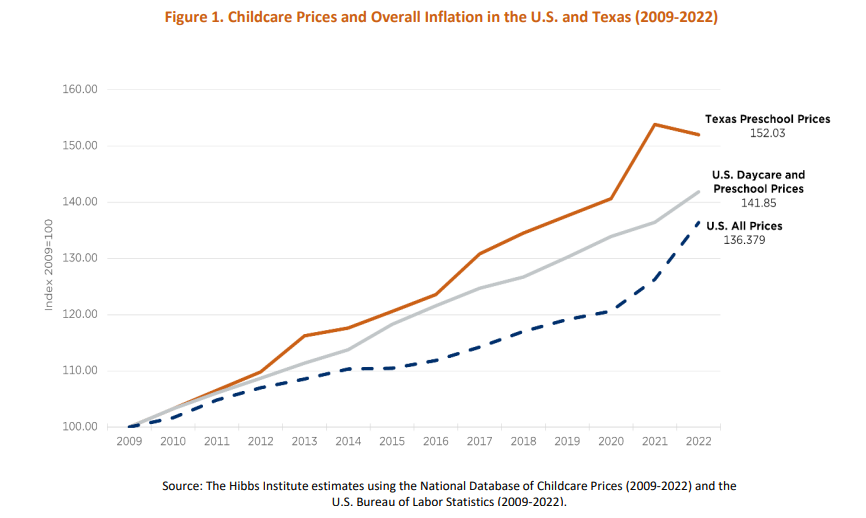
(substantial in the post pandemic years). Between 2009 and 2022, the price of preschool
care in Texas rose by 52%, while the U.S. rose nearly 42%, compared with a 36% increase
in general consumer prices over the same period.3 Figure 1 illustrates these variations using indexed numbers to allow for comparisons among
different indicators provided by the National Database of Childcare Prices and the
U.S. Bureau of
Labor Statistics.
A Shortage of Childcare Facilities in the United States
Over the last several decades, families in which all parents are employed outside
the home have become far more common. At the same time, research has increasingly
demonstrated that early care and education play an important role in children’s
academic success, health and social development. Together, these trends would normally
be expected to support a strong and responsive childcare market. In some areas, particularly
higher-income suburbs, the supply of childcare has expanded to keep pace with need.
However, this is not the case in several areas across the country where parents face
a shortage of accessible childcare options.4
An organization named the Center for American Progress (CAP) developed a concept to
determine if the number of available licensed childcare facilities is considerably
low relative to local demand in an area: a childcare desert. This metric conveniently
identifies where a shortage is present and how severe it is from
the conventional standard.4 According to CAP’s findings, more than half of the population across all 50 states
and Washington D.C. (51%) live in neighborhoods classified as childcare deserts.
Notably, the shortage is even more severe in rural areas, where families face the steepest barriers to access, with roughly three out of five rural communities lacking sufficient childcare options. Childcare deserts often push parents to make difficult
choices, such as relying on unlicensed care, family, or friends, and even stepping away from paid work.5 A national poll by The Washington Post found that more than three-quarters of mothers and about half of fathers had turned down work opportunities, changed jobs, or left their jobs because they lacked paid leave or reliable childcare.6
The Childcare Affordability in East Texas
Rising costs and limited childcare supply are challenges also experienced by East Texans. Provider closures following the COVID-19 pandemic, ongoing staffing shortages and low wages in the early-child workforce have restricted the system’s ability to expand in East Texas.7 In 2025, 39 zip codes in the Tyler area were classified as childcare deserts.8 When higher prices are combined with too few childcare options, affordability becomes a major problem for families. To better understand this, the Hibbs Institute developed the Childcare Affordability Index, which measures annual childcare expenses as a share of family income.9 Figure 2 depicts the Childcare Affordability Index for the 23 counties in East Texas. The U.S. Department of Health and Human Services considers childcare affordable when it accounts for no more than 7% of household income.10 Across East Texas, however, no county meets this benchmark. Families in the region typically spend between 9% and 13% of their income on childcare, with mild differences across counties.
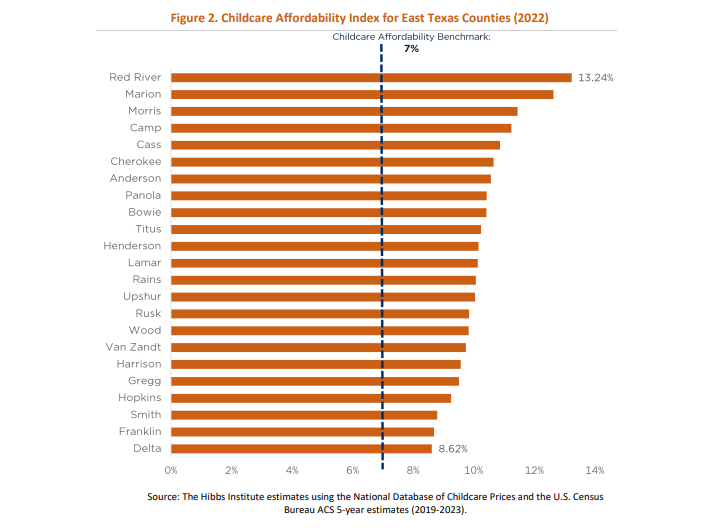
Even in areas where childcare prices are lower, family incomes are often too low to fully absorb the cost, leaving childcare persistently unaffordable for many households. It is important to keep in mind that these figures are expressed as a share of counties’ median family income. This means that lower-income families may spend even larger shares of their annual incomes on paid care per child.
A Critical Challenge for Regional Economic Growth
Access to affordable, high-quality childcare is essential for healthy child development
and family stability. Research consistently shows that early care and education support
children’s cognitive, social and emotional growth, with benefits that extend into
later educational attainment, health and social outcomes. While quality childcare
is costly for families, many of
its benefits extend beyond individual households, helping reduce inequality across
communities over time.
Childcare access also has significant economic implications. Reliable childcare functions as core employment infrastructure, enabling parents especially mothers — to remain in or reenter the workforce. Communities identified with childcare deserts where mothers stay home to take care of children tend to negatively impact the labor force participation rates in about three percentage points (or higher in low-income areas), which, in turn affects the local economy. Regions that have expanded childcare access have seen stronger female employment growth, suggesting that investing in childcare can support economic growth while promoting a more inclusive and equitable economy.
This information was also featured in the February/March issue of TYLER TODAY Magazine. Visit bluetoad.com/publication/?i=860376&p=48&vie w=issueViewer to read the article for free.
End Notes
Fund (CCDF). Federal Register, 89, 15366–15417. https://www.federalregister.gov/documents/2024/03/01/2024-04139/improving-child-care-accessaffordability-and-stability-in-the-child-care-and-development-fund-ccdf
The Hibbs Institute has created a LinkedIn page that frequently releases business and economic information. Follow our page for future brief updates, announcements and links to our periodic publications.
Hibbs Outlook: Childcare Costs, Access and Affordability in the United States with a Focus on
East Texas (February 2026)

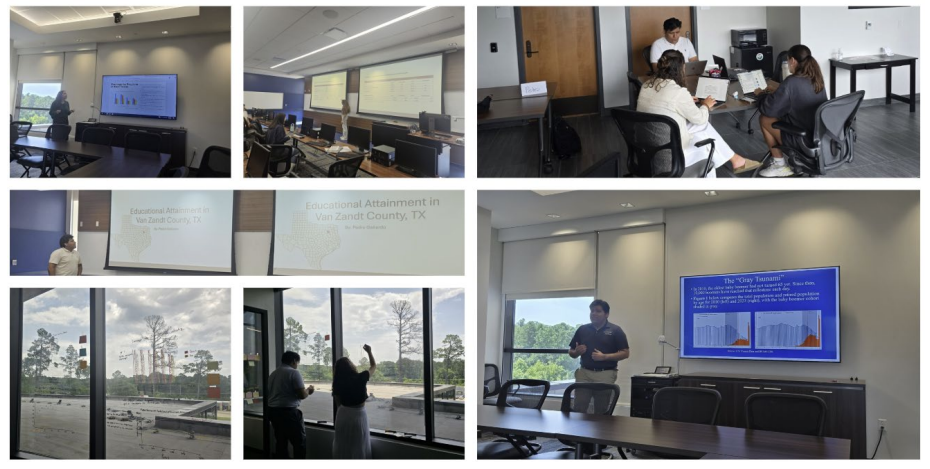
In fall 2024, the Hibbs Institute for Business and Economic Research launched the Hibbs
Internship Program — an intentional investment in cultivating the next generation
of regional
researchers and leaders. The program provides undergraduate students with hands-on
experience in economic analysis, allowing them to engage with real-world data and
contribute
to applied research focused on East Texas.
Sara Maldonado, one of the first participants in the program, played a central role in this
project. Reflecting on her experience, she shared:
“I am so grateful for the opportunity to contribute to this brief. One of the most
meaningful
lessons I am taking with me is that data is never just numbers, it represents the
real, often
difficult decisions families make under everyday constraints. This project deepened
my
understanding of how important it is to pair economic data with local context, and
to recognize
childcare not as a secondary social concern, but as essential infrastructure that
shapes
opportunity. Contributing to work that centers these realities has been both grounding
and
motivating, and it is an experience I will carry forward as I continue to engage more
deeply
with data and work to help break down barriers to opportunity for all.”
Sara’s perspective brings the purpose of this brief into sharp focus. Her reflection
is a reminder
that childcare data is not just a set of estimates, it is a window into the tradeoffs
families make
every week about work, income and time. By grounding the numbers in local conditions,
her
work reinforces a central point of this project: childcare is economic infrastructure
that shapes
labor force participation, business capacity and long-run opportunity across East
Texas.