Bioinformatics Core
Overview
The Bioinformatics Core of the Center for Biomedical Research at The School of Medicine provides comprehensive computational and analytical support for biomedical research. The Core serves all labs across the CBMR, supporting investigators in multi-disciplines, including molecular biology, immunology, cancer biology, neurology and microbiology.
The Core supports and promots collaborations among investigators across the School of Medicine and with external research partners. It collaborates with research teams throughout the scientific process, from experimental design and data management to advanced analysis, interpretation, visualization, and publication. Its analytical capabilities include high-throughput sequencing and multi-omics data analysis, such as whole-genome and targeted sequencing, RNA sequencing, single-cell sequencing, epigenomic analysis, comparative genomics and integrative bioinformatics. The Core also supports protein sequence, strucutre and metabolomics analyses.
In addition to research support, the Core contributes to bioinformatics education and workforce development. It provides bioinformatics instruction and practical computational training for faculty members, research staff, and students and supports the integration of bioinformatics for our Integrated Biomedical Sciences PhD program curriculum.
Together, these research collaboration and educational activities advance the Core's goal of strengthening th eCBMR's bioinformatics capacity and help investigators translate complex biological data into meaningful scientific discoveries.
Computational Resource - Texas Advanced Computing Center
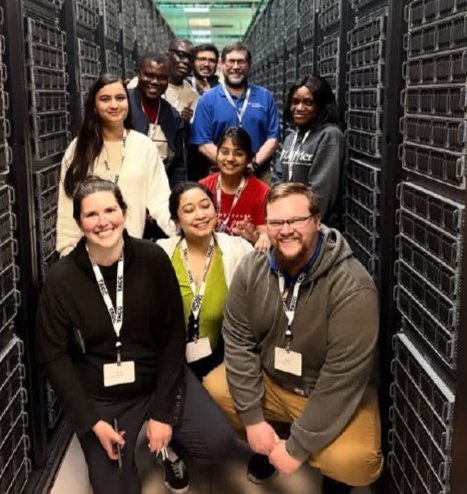 To meet the computational demands of large-scale biomedical datasets, Bioinformatics
Core uses high-performance computing resources available through the Texas Advanced
Computing Center (TACC). These resources enable efficient processing, analysis, and
secure management of complex genomics and other high-dimensional datasets. The core
is awarded by TACC as a UT System Core Allocation that includes 10 TB of secure data
astorage and ~10,000 units of CPU/GPU run time.
Publications
- Jimenez-Chavez L, Ding LH, Krieger S, Zhang Y, Babiak-Vazquez A, Berres M, et al.
Stratified longitudinal transcriptomic analysis indicates age-associated mitochondrial
dysfunction and immune response in astronauts aboard the ISS. npj Microgravity 2026.
- Ding LH, Story MD, Sulthana S, Squires RB, Edmondson EF, Weil MM. Mutational profiles
of hepatocellular carcinoma that arose in outbred mice after heavy-ion particle and
γ-ray radiation. BMC Genomics 2026.
- Honda JR, Wilsey RN, Raulerson CK, Ding LH, Castaneda CL, Joyner JL. Documenting environmentally
acquired Mycobacterium intracellulare subsp. chimaera pulmonary disease soon after
bronchiectasis onset. Clinical Infectious Diseases 2026:ciag015.
- Wilsey RN, Ding LH, Dawrs SN, Raulerson CK, Norton GJ, Virdi R, et al. Novel Hawai’i
and Pacific Island circulating clusters of Mycobacterium intracellulare subsp. chimaera.
Applied and Environmental Microbiology 2026:e00269–26.
Contact:
Dr. Lianghao Ding
Email: Lianghao.ding@uttyler.edu