New Study Reveals Discovery in Blood Clotting Process
February 23, 2026 | Elizabeth Wingfield
First Human Study of Key Clotting Protein
Popular Searches
February 23, 2026 | Elizabeth Wingfield
First Human Study of Key Clotting Protein
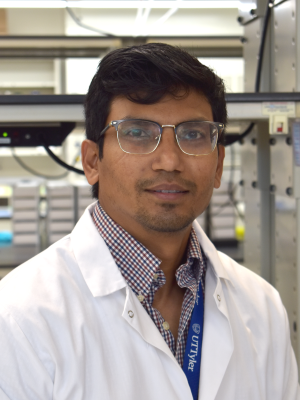 The University of Texas at Tyler School of Medicine Assistant Professor Dr. Shabbir Ansari, in collaboration with researchers from Beth
Israel Deaconess Medical Center and Harvard Medical School, has conducted the first
study examining tissue factor mutations in humans. Tissue factor is a protein in the
wall of blood vessels that begins the blood clotting process. Previous studies have
featured random tissue factor mutations created synthetically in a lab rather than
mutations that occur in real-life patients. Additionally, this research also demonstrated
for the first time that a specific mutation in tissue factor can also impair the activation
of another protein, Factor VII, which is essential to create a blood clot.
The University of Texas at Tyler School of Medicine Assistant Professor Dr. Shabbir Ansari, in collaboration with researchers from Beth
Israel Deaconess Medical Center and Harvard Medical School, has conducted the first
study examining tissue factor mutations in humans. Tissue factor is a protein in the
wall of blood vessels that begins the blood clotting process. Previous studies have
featured random tissue factor mutations created synthetically in a lab rather than
mutations that occur in real-life patients. Additionally, this research also demonstrated
for the first time that a specific mutation in tissue factor can also impair the activation
of another protein, Factor VII, which is essential to create a blood clot.
“This is a huge accomplishment for Dr. Ansari, the biomedical research community and the university,” said Dr. Torry Tucker, associate dean for research at the UT Tyler School of Medicine. “Dr. Ansari’s work exemplifies our commitment to scientific excellence and our growing role in global medical innovation.”
The study, featured on the cover page of Blood, the flagship, peer-reviewed journal of the American Society of Hematology, analyzed data from more than 800,000 human exome and genome sequences, linking rare mutations in the tissue factor gene to the start of the blood clotting process. Because standard medical tests do not directly measure this gene’s activity, it was previously unknown how much these mutations contribute to blood clotting issues in humans. The study found that certain tissue factor mutations impair the activation of many essential clotting proteins, suggesting these changes prevent the blood from clotting properly.
“For decades, no human mutation in the tissue factor gene had ever been shown to impair blood coagulation; in our study, we demonstrate for the first time that naturally occurring human tissue factor mutations can directly weaken the initiation of clotting,” said Ansari. “Because clinical tests do not measure tissue factor, our findings explain why some patients may face unexplained bleeding risks. This discovery paves the way for better diagnostic tools and more personalized care for patients.”
With a mission to improve educational and health care outcomes for East Texas and beyond, UT Tyler offers more than 90 undergraduate and graduate programs to more than 11,500 students. Through its alignment with UT Tyler Health Science Center and UT Health East Texas, UT Tyler has unified these entities to serve Texas with quality education, cutting-edge research and excellent patient care. Classified by Carnegie as a doctoral research institution and by U.S. News & World Report as a national university, UT Tyler has campuses in Tyler, Longview, Palestine and Houston.