UT Tyler School of Medicine Professor Optimizes New Antibiotic Treatment for Lung Disease
April 9, 2026 | Elizabeth Wingfield
Popular Searches
April 9, 2026 | Elizabeth Wingfield
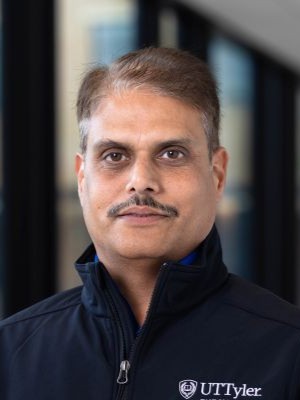 Dr. Shashikant Srivastava, a professor at The University of Texas at Tyler School of Medicine, optimized a new antibiotic combination for the treatment of Mycobacterium abscessus lung disease. His study was published in Antimicrobial Agents and Chemotherapy, an
American Society for Microbiology journal.
Dr. Shashikant Srivastava, a professor at The University of Texas at Tyler School of Medicine, optimized a new antibiotic combination for the treatment of Mycobacterium abscessus lung disease. His study was published in Antimicrobial Agents and Chemotherapy, an
American Society for Microbiology journal.
The bacteria, Mycobacterium abscessus, belongs to a group of nontuberculous mycobacteria and is naturally resistant to many antibiotics. Current treatment, including injectable drugs, can last for more than a year.
Srivastava, working with a team of researchers, is exploring beta-lactam antibiotics in combination with other drugs to create better and faster treatment option. Using an array of cutting-edge laboratory and computational tools that integrate artificial intelligence, their model predicted that sulbactam-durlobactam and ceftriaxone can be used as a backbone of therapy for Mycobacterium abscessus lung disease. They further tested sulbactam-durlobactam-ceftriaxone combination with other antibiotics, namely epetraborole, omadacycline and minocycline, to show that one of the identified new drug combinations administered for 27.15 weeks or 6.8 months could potentially cure more than 90% of cases — significant progress over the current therapy success rate of 30-40%.
The research was partially sponsored by the National Institute of Allergy and Infectious
Diseases — a division of the National Institutes of Health — the Cystic Fibrosis Foundation
and support from the UT Tyler School of Medicine.
a division of the National Institutes of Health — the Cystic Fibrosis Foundation
and support from the UT Tyler School of Medicine.
“These results represent the methodological contribution of the hollow fiber model system and advancement of clinical trial simulations with virtual patients for sulbactam-durlobactam-ceftriaxone in a fixed-dose combination examining the effects of adding a third drug. Implementing artificial intelligence in developing newer Mycobacterium abscessus lung disease treatment is a significant milestone and offers hope for patients struggling with this antibiotic-resistant nightmare. We have plans and looking for funding mechanisms to test these antibiotic combinations for clinical validation,” said Srivastava.
Srivastava received his PhD in environmental science from Babasaheb Bhimrao Ambedkar University in Lucknow, India. He previously served as an associate professor at Texas Tech University Health Sciences Center in Dallas and joined UT Tyler in April 2020. In addition to several extramural grants, he’s also received a Science and Technology Acquisition and Retention award from The University of Texas System to pursue his mycobacteria research.
You can find the article at doi.org/10.1128/aac.01437-25.
With a mission to improve educational and health care outcomes for East Texas and beyond, UT Tyler offers more than 90 undergraduate and graduate programs to more than 11,500 students. Through its alignment with UT Tyler Health Science Center and UT Health East Texas, UT Tyler has unified these entities to serve Texas with quality education, cutting-edge research and excellent patient care. Classified by Carnegie as a doctoral research institution and by U.S. News & World Report as a national university, UT Tyler has campuses in Tyler, Longview, Palestine and Houston.