Electrical and Computer Engineering
Contact Us
Department of Electrical Engineering
RBN 2005
3900 University Blvd.
Tyler, TX 75799
Office Hours:
M-F 8 a.m. - 5 p.m.
800 UT TYLER
Ph: 903.566.7417
Fx: 903.565.5877
ee@uttyler.edu
The Department of Electrical and Computer Engineering at The University of Texas at
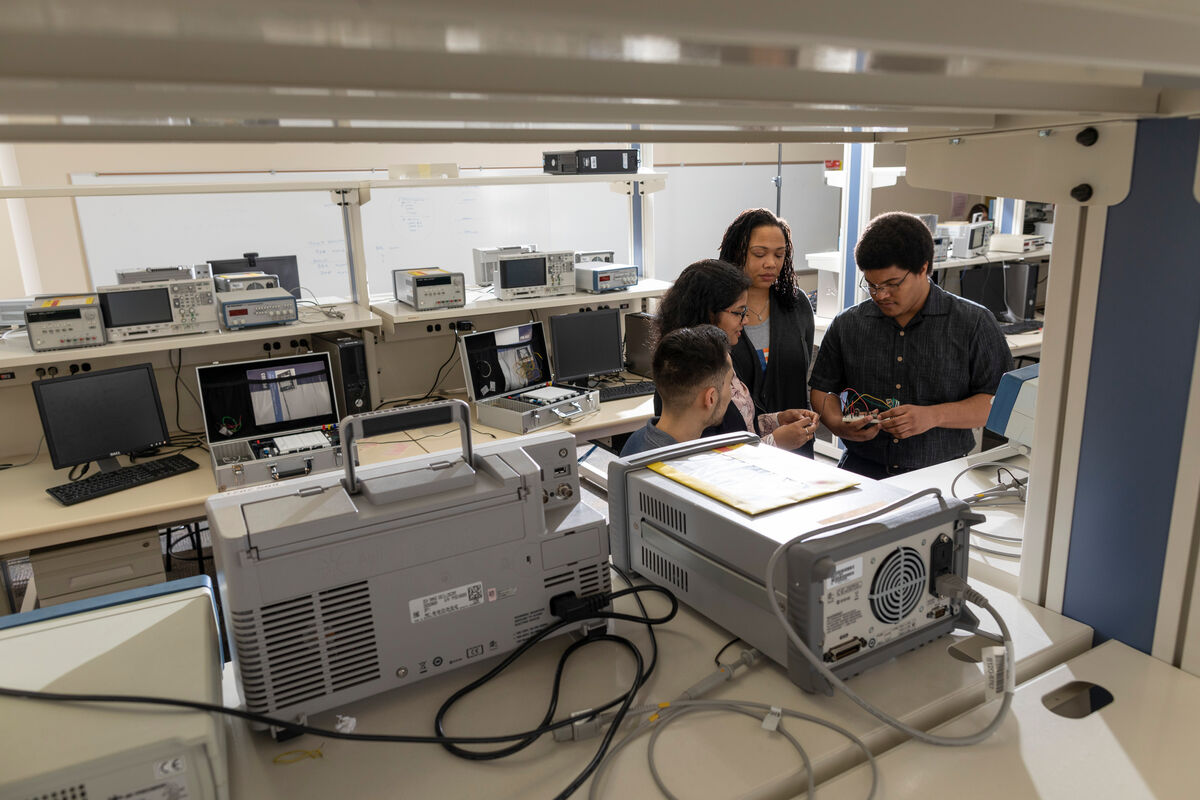
Tyler offers a student-focused, hands-on approach to Undergraduate and Graduate engineering education, providing excellent preparation for success in today's high
tech world. Students may choose to study at our main campus in Tyler, or they may
earn a UT Tyler Electrical or Computer Engineering Bachelor of Science degree through
our satellite program in the Houston Engineering Center of Houston Community College.
Our Electrical Engineering program provides students with a comprehensive education to apply science, mathematics and technology coupled with critical thinking and problem-solving skills to analyze, design, construct and maintain products and provide services related to electrical and electronic devices and systems. With a degree in electrical engineering from UT Tyler, you will be well trained to work in many vital areas, including electrical circuit design, analog and digital electronics, microelectronics, computer engineering, communications, digital signal processing, control systems, power systems and energy conversion. Whether designing large electric power systems to provide energy to homes and industries or developing tiny electronic devices to save lives, an electrical engineer is afforded many opportunities for a challenging and rewarding career.
- The UT Tyler electrical engineering Bachelor of Science degree provides a strong theoretical foundation, practical engineering skills and experience in communication and teamwork, preparing students to practice as professional engineers and/or to begin graduate studies. This degree is an important qualification for those seeking employment in industry, as well as a solid foundation to begin graduate studies.
- UT Tyler's electrical engineering Master of Science degree program offers advanced instruction in two or more areas, including: electronics, power systems, controls, advanced engineering mathematics, signal processing, communications, real-time systems, computer systems, electromagnetics and power electronics.
Electrical Engineering students receive individualized instruction from faculty with diverse industrial backgrounds. Each faculty member holds an advanced terminal degree, and most have actively practiced engineering.
The Electrical Engineering program is accredited by the Engineering Accreditation Commission of ABET. For more information, please feel free to contact Dr. Hassan El-Kishky, Chair and Professor of Electrical Engineering.
Our Computer Engineering program provides students with a comprehensive education that integrates electrical engineering and computer science to prepare graduates for the design and development of modern computing systems. The curriculum emphasizes digital logic and computer architecture, embedded systems, microprocessors, electronics, programming, data structures and algorithms, computer networks, cybersecurity, and hardware-software integration, supported by laboratory and hands-on design experiences. Special emphasis is put on emerging areas of study including artificial intelligence (AI), machine learning (ML), deep learning, generative and agentic AI, edge AI, intelligent embedded systems, autonomous systems and robotics, computer vision, and AI-enabled Internet of Things (IoT). Through coursework, laboratories, research opportunities, and multidisciplinary capstone projects, students learn to integrate AI and ML algorithms with computing hardware and embedded platforms, preparing them for careers in rapidly evolving fields such as intelligent systems, autonomous technologies, advanced computing, semiconductor systems, robotics, and AI-enabled engineering applications.
Marketable Skills
Students exit from any degree program with a variety of skills. Marketable skills are those valued by employers that can be applied in a variety of work settings, including interpersonal, cognitive, and applied skill areas. These skills can be either primary or complementary to a major and are acquired by students through education, including curricular, co-curricular, and other non-classroom activities (Texas High Education Coordinating Board, 2015).
Electrical Engineering graduates develop hands-on skills in circuit design & analysis, systems programming & microprocessors, power & control systems, signal processing. Students gain practical experience with PCB design tools, circuit simulation, virtual machines, and electrical / electronic laboratory instrumentation.
Computer Engineering graduates develop hands-on skills in embedded systems and microcontrollers, C/C++ and assembly programming, FPGA and VHDL design, VLSI and CMOS design, computer architecture, PCB design and hardware prototyping, operating systems and Linux, computer networks, signals and systems, machine learning, and hardware-software integration. Students gain practical experience with ARM/STM32 microcontrollers, FPGA platforms, CAD and PCB design tools, circuit simulation, virtual machines, and electronic laboratory instrumentation.
Through laboratory projects, Senior Design, and industry or research experiences, students also develop engineering problem-solving, system integration, technical communication, teamwork, project management, and professional engineering skills.
Syllabi
- Undergraduate
- Graduate