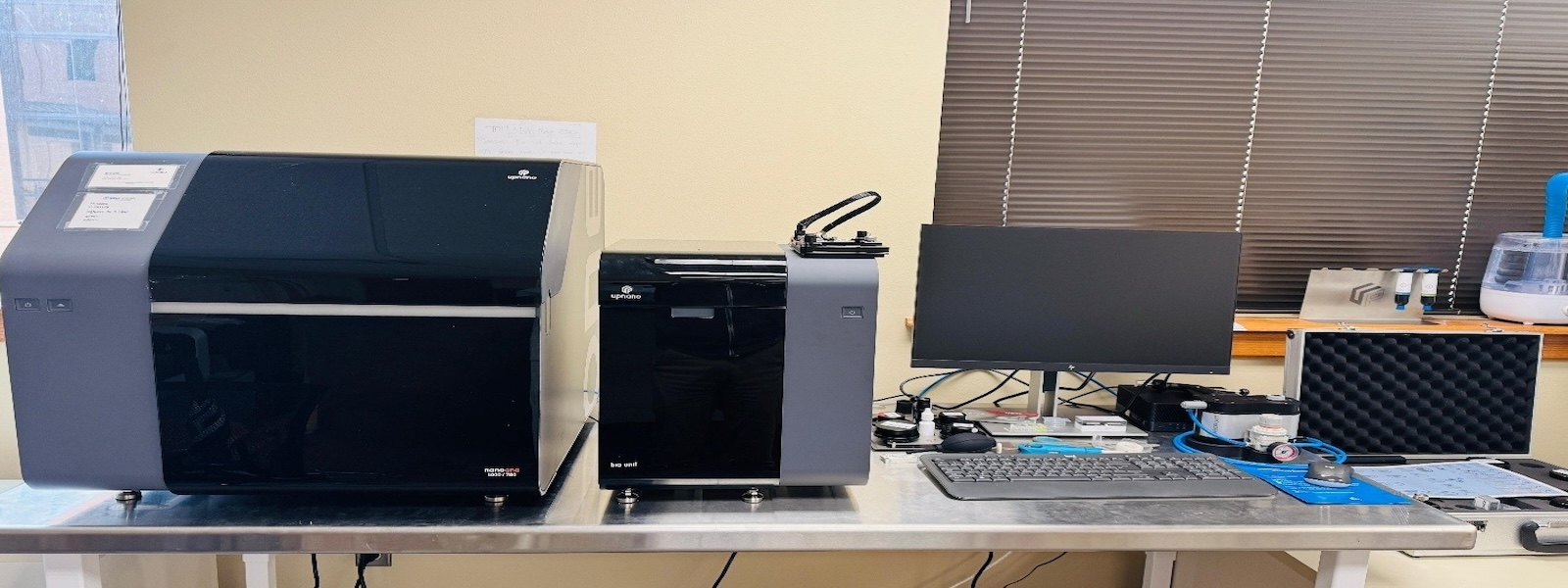
NanoOneBio
Overview
The NanoOneBio is a high-resolution two-photon polymerization-based 3D printer that
enables the fabrication of microscale and complex three-dimensional structures with
exceptional precision. At CeSAT, we use the NanoOneBio to rapidly prototype and manufacture
high-resolution sensor architectures, allowing us to create finer electrode features
and intricate sensor designs that are difficult to achieve with conventional fabrication
methods. This capability accelerates the development of next-generation wearable,
plant, and environmental sensors while improving device performance, reproducibility,
and design flexibility.
This instrument was funded by National Science Foundation Award # 2408664
More details of the award can be found here: NSF AWARD
Research Projects
The NanoOne instrument is being used in our current NASA-funded project, where it
enables the fabrication of high-resolution microneedle structures required for plant-integrated
sensing.
The project team has recently presented some preliminary findings from this project
at the IEEE International Conference on Flexible and Printable Sensors and Systems
(FLEPS) in Atlanta, Georgia on July 12, 2026. Below is the citation for this work.
John Opoku, A K M Sarwar Inam, Rachel Tucker (NASA), Anirudha Dixit (NASA), Natasha Haveman (NASA), and Shawana Tabassum, PhD. “Microneedle-Assisted Electrochemical Sensor for Real-Time Nitrate Monitoring
in Tomato Stem,” presented at the 2026 IEEE FLEPS conference, July 12, 2026, Atlanta,
Georgia.
User Manuals
Safety and Training
Photo Gallery
Videos and Demonstrations
Contact and Access