Contracts & Procurement Processes
Every purchase begins with a simple request, “I need something.” It is our goal to enable you to respond with “here it is” as quickly and cost effectively as possible. However, each purchase has statutes, regulations, and policy defining these processes for us as a state institution of education.
When do you need an agreement/contract?
- The contractor requires a signature or agreement.
- The purchase is $15,000 or above.
- The purchase is software related.
- The purchase is for professional services (i.e., the contractor is required to be licensed or certified).
- The purchase is for catering or food trucks.
- The purchase is for construction.
- The purchase is a service agreement with a consultant, performer/entertainer, speaker/presenter/instructor.
8 Key Questions
This guide aims to broadly walk you through this complex process and direct you to the key resources, departments, and systems required to navigate procurement successfully. Below, you will find 8 key questions or steps to follow as you determine the next step in the process for your need:
- Who is in charge?
- What is it and what is your timeline?
- How much is it?
- Is there an existing contract?
- How many bids/quotes are needed?
- What goes into Symplr?
- Who approves/reviews this?
- How do I pay?
Key Questions
Before you get started it is important to know whose approval will be needed for your purchase. While the employee who requested the item for purchase (the requestor) may have knowledge of funds for your purchase, a budget authority’s approval is needed for any purchase with university funds.
For large purchases, your dean or vice-president will also need to approve the expense later in the process. For grants, there is an employee tasked with managing the specific grant funds and will often have a different chain of approval. So, including these leaders before you get started can often save you complications later in the procurement process.
Common approvers in this process include:
- Chair
- Dean
- Director
- Budget Authority (BA)
- Vice-President
- Chief Business Officer
What the item/service is will change the processes needed for its acquisition due to factors like federal regulations, state legislation, and UT Tyler policy. Those required approvals, negotiations, and logistics often have distinct timelines which will affect how quickly you can procure your item or obtain approval for your needed service.
Here are some of the main categories of items and their unique requirements:
Services – consulting, maintenance, or training. Hiring a person or company to perform work for the university is labeled as a service. Services often require additional review for risk, insurance, and contract terms. Contracts are required for all services acquired by the university.
- Service agreements often need to be initiated six weeks before the date when they are needed in effect.
Food – catering, meals, or refreshments for events or meetings. Food purchases must follow state rules, university policy, and sometimes require justification for the business purpose. Food trucks have additional requirements. If caterers will serve the food themselves on campus, then a service contract will be required.
- Expect hiring caterers or food trucks to take 3 to 6 weeks.
- Expect buying food to take 1 to 3 business days.
Joint/Organizational Agreements – formal agreements with outside organizations, such as partnerships, sponsorships, or shared programming. These require review to ensure compliance with university and UT System standards.
- Agreements often need to be initiated one 6 weeks before the date when they are needed in effect.
Technology (software or hardware) – computers, software licenses, cloud services, or specialized lab equipment. These require IT review to ensure compatibility, security, and accessibility compliance. All software purchases, both new and renewals, should start by filling out the technology assessment form and will require an agreement.
- Expect approval on software purchases to take 33 to 99 business days due to EIR Accessibility review.
- Expect standard computer purchases to take from 2 to 3 weeks.
Goods – physical items or supplies, from office furniture and lab materials to uniforms or equipment. The procurement process will vary depending on cost thresholds and existing contracts. If the item contains university branding, an authorized, licensed vendor is required
- Expect unbranded goods to take 1 to 3 business days.
- Expect branded goods to take 3 to 4 weeks.
Once you know what it is, the amount of your purchase will also affect the process due to regulations and policy. These price ranges fall into four brackets:
- Under $15,000 – Small purchases can often be completed quickly with minimal paperwork if no signature is required by the vendor. In many cases, only one quote is needed, and payment can be made by purchase order, eShop, or ProCard. (ProCard purchases require further approval when over $499.)
- Between $15,000 and $50,000 – Requires at least three competitive quotes. Documentation of the quotes must be included in the procurement process before a purchase order can be issued. (Recommend asking for a quote with an expiration of 30 days or greater)
- Between $50,000 and $100,000 – Requires a more formal solicitation process and multiple competitive bids. This could be through a Request for Proposal (RFP) though is not required. The Procurement Services department will guide you through the bidding and contract requirements.
- Over $100,000 – Requires a formal bid or Request for Proposal (RFP) process managed through Procurement Services. These purchases often take more time due to legal requirements, contract negotiations, and required executive approvals.
If the “what” or the “how much” questions revealed you need a contract or agreement, then the first question you need to ask is if there is already an existing contract. This could take many forms:
- If there is an existing UT Tyler contract or UT System level contract, then you can often pay via purchase order (PO) without any additional contract needed.
- If there is an existing UT Tyler contract, but it is about to expire or changes are needed, then you will need to start a new workflow in Symplr within the expiring contract. Be sure to add the previous contract as you proceed through Symplr.
- If there is GPO or sister institution contract, then an addendum will be needed with UT Tyler specific information. The contents of this addendum will be determined through questions in Symplr.
- If you received a contract from the vendor, then an addendum will be needed with UT Tyler specific information. The contents of this addendum will be determined through questions in Symplr.
- If there is no current contract, you will need to start a new contract in Symplr.
While contracts and agreements are two different types of legal documents, our contract management software, Symplr, will help guide you to the correct language needed in each. The bottom line is that if your UT Tyler document needs a signature, Symplr will be needed to acquire that signature.
The answer to this question is highly dependent on the amount of the purchase:
- Under $15,000 - Only one quote is required. Departments are encouraged to compare prices when possible, but formal competitive bidding is not required.
- From $15,000 to under $50,000 – Requires at least three competitive quotes two of which classify as Historically Underutilized Businesses (HUB vendors)), if available. Documentation of the quotes must be included in the procurement process before a purchase order can be issued. If you decide to not use the lowest bid, an Exclusive Acquisition Justification Form (EAJ) is required as a written justification documenting your reasoning.
Informal Bids and Hub Searches
- From $50,000 to $100,000 - Requires a formal solicitation managed with the assistance of Procurement Services. Multiple bids must be sought, and the process is more structured than informal quotes. Purchasing Guidelines
- Over $100,000 - Requires a full competitive bidding process, typically a Request for Proposal (RFP) or Invitation to Bid (ITB), managed directly by Procurement Services. This is the most formal process and often involves extended timelines for review and approval.
It is recommended for quotes from vendors to have an expiration of 30 days or longer. For any of the categories that require multiple bids, a decision matrix document is required.
Once you have selected a bid, you can start on the following action items before getting started in Symplr:
- Check in Payment Works to ensure the vendor is an approved state vendor. If they are not, follow the workflow in Payment Works to get them added. PaymentWorks Supplier/Payee Guide
- Start a requisition in UT Share. The number of this requisition will be needed at each of the subsequent steps. Create Requisition Guide
- If you plan to select a vendor which is not the cheapest option, you will need to
fill out an Exclusive Acquisition Justification Form (EAJ) in Docusign. This document
contains an explanation of the university need and unique solution this purchase provides.
Be prepared to provide supporting documentation, such as product specifications or
evidence that no comparable alternatives exist. Procurement Services must review and
approve an EAJ before the purchase can proceed. Examples:
- Proprietary items
- Items only available from one vendor
- Items only compatible with existing equipment/software
- Items needed on an emergency basis
- Proprietary items
Now you can get started in Symplr. Start with a university provided contact, a vendor provided contract, or fill out one of the following templates:
If your purchase involves food:
-
-
- Catering Agreement
- Food Truck Agreement - with cash sale or non-cash sale
-
Other purchases:
Through a series of questions, Symplr will determine the pieces and language of the contract needed to abide by our policies. While we understand you may not know the answers to every question, please try to answer all of the questions to the best of your ability with as much detail as you can. Your answers will be reviewed by the appropriate UT Tyler departments before moving forward. Make sure to include all of the documents you have utilized up to this point. This could include:
- Selected quote
- Exclusive Acquisition Justification Form (EAJ) if needed
- Certificates of Insurance (COI) if needed - All vendors performing work on university property must be properly insured. COIs are evidence of this coverage defined in a single document. Contact the Risk Assessment department to discuss your specific circumstances and determine appropriate coverage. Insurance FAQ
Contact the Contract Management team if you have any questions.
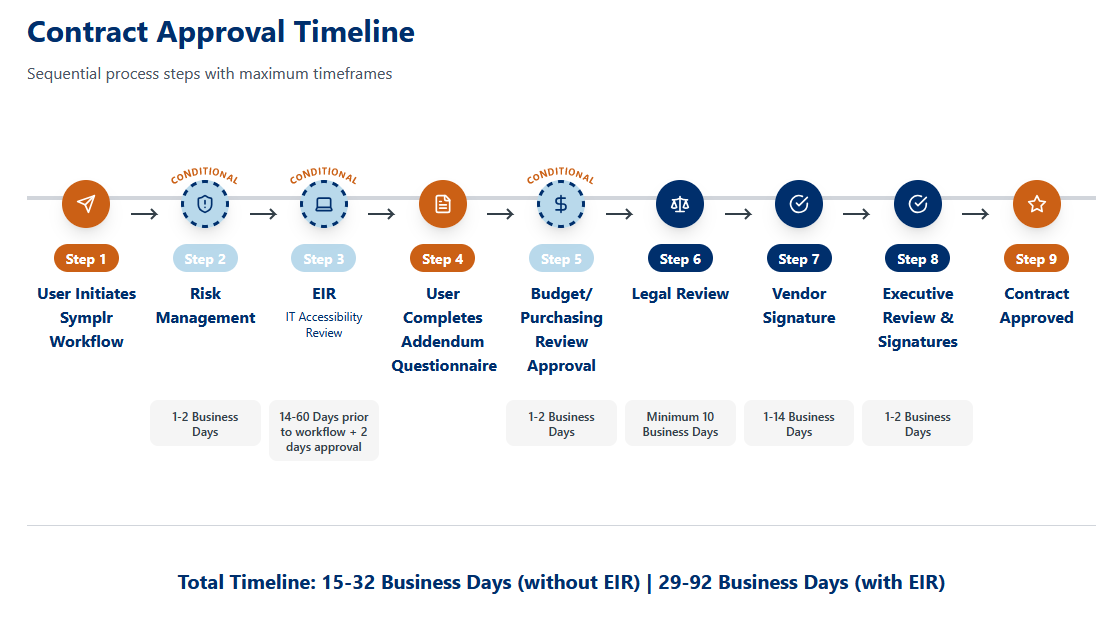
As we determined in step 1, who approves your purchase will vary based on what it is and how much it costs/if at all. Symplr will navigate the approval chain through notifications and emails. At any given moment, you can check the system to see how many days and with whom the process currently sits. It may take a friendly reminder from you, your requestor, or supervisor to move the approval process forward.
This step in the process can often get held up for several reasons:
- Negotiations with vendors often take time.
- Contract sitting with vendor waiting for a final signature.
- Approval can sit in the inbox of someone out of the office or inaccessible. If you cannot wait for them to return, consider (asking their supervisor and contact contract administration to move the process along.)
- Missing early steps will hold up the entire process. Make sure to catch those pre-Symplr steps for your individual purchase needs like filling out the technology assessment form or emailing Risk Management for an insurance assessment.
- Changes in roles. If you notice your contract has been sitting with an individual for an extended period and you know they have either shifted job roles/responsibilities or are no longer with the institution, please reach out to Contract Administration so they can work towards moving your contract along to the correct individuals.
As you determined earlier in this process, the price of your purchase may limit your payment options:
Purchase Order (PO) – A PO is a formal document issued by UT Tyler to a seller that specifies the products or services they want to purchase and other relevant details. POs are issued by the Procurement Team or instigated by you through UT Share. View more information.
Procards – Procurement Cards are credit cards issued by UT Tyler to qualified full-time employees, whose job duties include purchasing for the department. Your department may request a Procurement credit card if approved by the department budget authority or if the Procurement credit card is for the budget authority. View more information.
eShop – The eShop is an online shopping tool that allows the University to take advantage of pre-negotiated contracts for pre-approved goods from well-known suppliers. Check out the “Shopper” page in UT Share for access. View more information.
Even when you follow each step carefully, complications may arise. Approvals may sit in inboxes, a form may be missing, or additional review may be required. You don’t have to solve every problem alone; several offices across campus are here to help you keep the process moving:
Procurement Services
helps with purchase orders, requisitions, quotes, vendor setup, eShop questions, and
general purchasing policy. They’re your go-to for issues related to bids, pricing
thresholds, or “how to buy” questions.
Contract Administration
manages all contracts, agreements, and Symplr workflows. Contact them if a contract
is stuck in Symplr, if you need guidance on addenda, or if you’re unsure which contract
form is needed.
Financial Services / Accounts Payable
processes invoices, payments, ProCards, and reimbursements. Contact them if payment
is delayed, if you need help reconciling a PO, or if a vendor is asking about payment
status.
Email Financial Services/Accounts Payable
Budget Office
approves use of university funds and verifies funding sources. Contact them if budget
approval is holding up your request or if you’re unsure which account to charge.
Risk Management
assesses liability and insurance requirements for vendors providing services on campus.
Reach out if you’re purchasing services, hosting events, or unsure whether insurance
certificates (COIs) are required.
Information Technology
reviews technology-related purchases (hardware, software, cloud services). Contact
IT for required forms (like the Technology Assessment), compatibility checks, or accessibility/security
reviews.
The Office of Research, Scholarship, and Sponsored Programs
handles purchases funded by grants. They ensure purchases align with grant guidelines
and sponsor restrictions. Contact them if you’re unsure of approval chains or allowability
for grant-funded items.
Email Research, Scholarship, and Sponsored Programs Office
Department Leadership (Chair/Dean/Director/Vice President)
keep your college or division leadership in the know. Sometimes a request is stuck
simply because it’s sitting in someone’s inbox; contacting your approver directly
(or their office) can move things along.
Requisitions are the formal request to purchase goods or services using university funds. It is entered into UT Share (PeopleSoft) by the department making the purchase and includes key details such as vendor, item description, quantity, price, and funding source. Once submitted, the requisition routes through the appropriate approval and, if approved, is converted into a Purchase Order (PO).
Purchase orders (PO) are formal document issued by UT Tyler to a vendor that authorizes the purchase of specific goods or services. It confirms the agreed price, quantity, delivery terms, and other conditions. A PO is created after a requisition is approved in UT Share (PeopleSoft) and serves as the university’s official commitment to pay the vendor once the goods or services are delivered.
Procurement Cards (ProCard) are a university-issued credit card that allows authorized employees to make small,
routine purchases directly on behalf of UT Tyler. It’s intended for low-dollar, low-risk
transactions such as office supplies, small equipment, or travel-related expenses.
Using a ProCard can speed up the purchasing process because it bypasses the need for
a requisition and purchase order, as long as the purchase follows university policies
and spending limits. Each ProCard is tied to a departmental budget and must be reconciled
monthly with receipts.
Quotes are written estimates from a vendor which outlines the price, specifications, and
terms for the goods or services you want to purchase. Quotes are used to compare options,
ensure compliance with procurement rules, and document that the university is receiving
fair pricing.
Requests for Proposals (RFP) are a formal, competitive bidding process used for complex or high-value purchases (typically over $50,000). In an RFP, UT Tyler outlines the university’s needs and invites vendors to submit detailed proposals explaining how they would meet those needs, along with pricing and terms. Unlike a simple quote or bid, an RFP allows the university to evaluate multiple factors, such as quality, service, experience, compliance, and price, before awarding the contract. RFPs are managed by Procurement Services and must follow state procurement statutes and UT System policies.
Exclusive Acquisition Justification Forms (EAJ) are the form used when you need to purchase a specific product or service without
seeking competitive bids. The EAJ explains why only one vendor can reasonably provide
what the university requires. Procurement Services must review and approve an EAJ
before the purchase can move forward. Documentation supporting the justification is
usually required.
Certificates of Insurance (COI) are insurer provided documents which summarize an insurance policy's key details. They serve as proof that a person or business has the necessary insurance coverage required by a contract and are often used in business transactions to protect against liability. Key details often include information on coverage types, policy limits, and expiration dates.
Addendums are legal documents used to modify or supplement an existing contract or agreement.
Instead of creating an entirely new contract, an addendum is added to clarify terms,
extend dates, adjust pricing, or include UT Tyler–specific requirements. In the procurement
process, addenda are commonly needed when, a vendor provides their own contract that
must be customized with UT Tyler’s required terms, A UT System or Group Purchasing
Organization (GPO) contract is used but needs campus-specific details, or an existing
UT Tyler contract is extended, renewed, or changed.
Group Purchasing Organizations (GPO) are entities which negotiate contracts with vendors on behalf of multiple institutions,
allowing members (like UT Tyler) to benefit from pre-negotiated pricing, terms, and
compliance. Using a GPO contract can save time and money because the competitive bid
process has already been completed. However, most GPO contracts still require a UT
Tyler–specific addendum in Symplr before they can be used. Common examples include
contracts available through UT System agreements or state-level purchasing cooperatives.
Departmental Contract Administrators (DCA) are designated employee within a department who manages the purchasing and contract
process on behalf of their unit. DCAs serve as the main point of contact between their
department and Procurement Services, Contract Administration, and other offices involved
in approvals. While DCAs help manage the process, ultimate spending authority still
rests with the budget authority or executive approvers in their college or division.
Symplr is UT Tyler’s contract management system. It is the online platform used to create,
route, review, and approve contracts and addenda. If a purchase or agreement requires
a signature on behalf of the university, it must go through Symplr. Symplr helps ensure
that all contracts comply with state statutes, UT System rules, and university policy
before they are signed.