Module 6
Effective Consequences
Welcome to Module 6! In the last module, we covered how to give effective commands and how to remove attention from unwanted behavior through active ignoring and time-out. In this module, we will learn how to effectively implement other consequences when your child misbehaves. The goal is to create a menu of options so you can choose how to best respond to your child’s unhelpful choices.
Remember that the best thing you can do is be consistent! The more consistent you are, the quicker your child will associate positive behaviors with praise and rewards and negative behaviors with consequences. Consistency will also minimize boundary testing and help your child learn that you are serious about rules! We know introducing new rules and consequences can be challenging, and we want you to enjoy the benefits of a positive, predictable home!
Now, let’s jump into effective ways to respond to unhelpful behaviors!
Natural Consequences
The goal of discipline is for your child to learn to make helpful choices. The best way to teach the association between behavior and consequence is to discipline using natural consequences. Natural consequences are simply consequences that logically follow a specific behavior. Some common natural consequences include:
- If you make a mess, then you clean it up.
- If you break a toy, then you no longer have that toy.
- If you take too long to get out of the door, then you have less time to do fun things.
- If you refuse to wear a coat, then you will be cold.
- If you play with your food, then you will have none for later.
- If you stay up late, then you will be tired the next day.
Removal of Privileges
Removing privileges is an effective way to increase compliance, especially in older children. By offering clear and consistent rules, kids learn that their privileges depend on their choices.
- Select behaviors: Decide what behaviors will be dealt with by removing privileges. You may include any and all behaviors that your child struggles with, both minor and major. Start by choosing 2 to 3 problem behaviors.
- Choose appropriate consequences: When selecting effective consequences, consider both what is feasible and what will
motivate your child. Effective consequences should be:
- Feasible: Make sure to select a privilege that you can actually remove in a timely manner. For example, if you work until 5:00pm, it may be challenging to remove the privilege of watching TV in the afternoon.
- Logical: Whenever possible, the consequence should be associated directly with the behavior. For example, it may not make sense to remove screen time privileges for failing to put the bike away. A more logical consequence would be losing bike privileges for the next day.
- Motivating: Remove a privilege that will matter to your child. If your child loves blocks, consider removing toy blocks for 2 hours as a consequence. However, this will not be motivating if your child hasn’t touched their toy blocks in months!
- Focused: Consider how removing certain privileges will affect others. For example, if you take away TV time, what will happen when other family members want to watch something?
- Time limited: Some parents make the mistake of taking away privileges for too long. We recommend that a privilege be removed for no longer than 24 hours. In fact, parents often get better results by removing privileges for a shorter period of time, such as taking away a toy for a couple hours or removing one episode of TV. When kids have the opportunity to get their privileges back, they are often more motivated to comply!
- Not overly punitive: If consequences are overly punitive, discipline becomes a source of anger or resentment instead of a learning experience. Consider how removing certain privileges will affect your child. If you remove the privilege of attending sports practice, will your child lose playing time? Will they lose a way to get their energy out in a helpful way?
- Clearly define the consequences: Let your child know ahead of time what consequences are associated with what behaviors. Consider creating a list with pictures and cues, so your child remembers the consequences.
- Be quick and calm: When your child breaks a rule, immediately let them know that they have lost a privilege. Use language such as “Because you did not keep your hands to yourself, we have to leave the park” so your child knows exactly why they are losing a privilege. Remember, stay calm and collected during this process!
- Move on: After you have removed the privilege, actively ignore attempts to get your attention in a negative way, such as crying or pleading. Once your child has served their time, calmly restore the privileges.
Token Economy
For older children, implementing a token economy can teach delayed gratification and good decision making. Think about a token economy as an extension of the rewards chart we discussed in Module 4. Kids will continue to be able to earn rewards with helpful behaviors, but they will now risk losing potential rewards with unhelpful behaviors.
When setting up a token economy, consider the following things:
- Clearly define behaviors: Select behaviors that are clear, simple, and attainable. As your child gets older and more experienced with the token economy, behaviors may become more complex. For example, initial behaviors could include “making your bed”, “picking up your toys”, and “putting away your clothes”. Once your child has mastered those behaviors, you could merge them into “cleaning your room.” For most children, we recommend keeping unhelpful behaviors positively stated and straightforward such as “keep your hands to yourself” and “use kind words” rather than “don’t be mean.”
- Determine rewards and consequences: A point system works well with a token economy. Clearly define how many points your child will earn for each helpful behavior. Similarly, define how many points they will lose for each unhelpful behavior. Tally up points at least once per day, so your child knows how they are doing.
- Offer choices: As your child gets older, you can offer more choices for rewards. Kids may choose from smaller, short-term rewards, like dessert or extra screen time. Alternatively, they may “save up” their points for larger rewards like a trip to the movies.
- Give opportunities to earn: Some parents also like to include opportunities to earn back points and/or earn additional points. Consider offering your child points for completing extra chores, for helping siblings, for reading extra books, and so on. Kids are often motivated to stick with a token economy when they have a chance to earn rewards faster!
Let's take a look at a sample behavior chart using a token economy: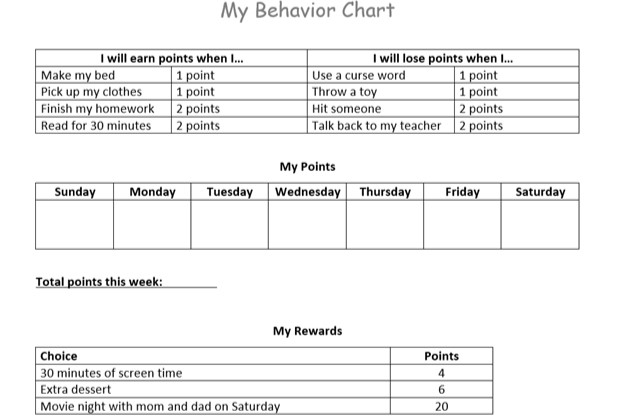
Notice that:
- Behaviors are clearly defined and simple
- The child has just as many opportunities to earn points compared to opportunities to lose points
- The child is allowed to use their points daily or to save up their points to earn a larger reward at the end of the week
Download the blank Token Economy Chart below and try it out with your child!
Handouts
Responding to Challenging Behavior
Module 6 Action Steps:
- Plan it: Identify 3-5 problem behaviors in your home and decide how you would like to respond: natural consequences, removal of privileges, or token economy?
- Implement it: Let you child know about the new consequences that will be implemented in the home. Download one or more of the templates so your child remembers what behaviors are associated with what behaviors.
- Reflect: Is the chosen effective consequence feasible and motivating? Or would it be helpful to choose a different approach?
- Self-Compassion: Starting something new can feel like another thing to add to your plate, do not forget to reward yourself! Take some time to give yourself some praise for your efforts towards a better parent-child relationship.