Module 7
Managing Behavior Outside the Home
Extending strategies that you have learned beyond your front door is an important component of successful parenting. Your child’s success in school and the community is a team effort. This module will discuss practical tools to a partner with your child’s teachers, create a continuation between home and school, and if necessary, advocate for your child’s needs.
Visual Schedules
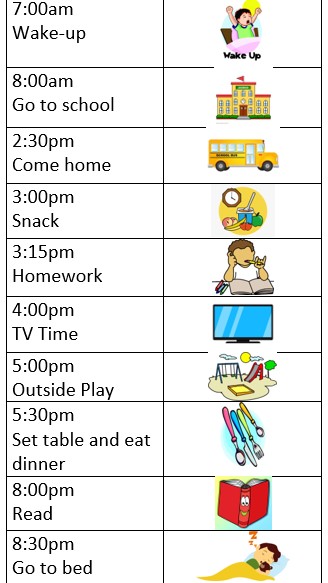
Creating a visual schedule can help prevent inappropriate behaviors inside and outside the home by helping your child know what to expect. Children thrive on routines and are more likely to be emotionally regulated and well-behaved when they are prepared for the day. Visual schedules can cover the entire day, morning and evening routines, weekends, and more! Make sure to include what you are doing, what time you are doing it at, and a simple picture to help increase retention.
Let’s take a look at a full day visual schedule:
Prepping for Outings
Set your child up for success by preparing for outings ahead of time.
- Review the schedule: Talk about what you will be doing and for how long. Give your child 10-minute, 5-minute, and 1-minute warnings to help ease transitions.
- Set rules: Let your child know the rules before setting out. Rules could include holding onto the cart in the grocery store, using an inside voice, not getting a toy in the store, or staying safely. Make sure your child also understands the rewards and/or consequences if they fail to follow the rules. For example "If you hold onto the car while we shop, you can pick out one piece of candy" or "If you do not use your inside voice, we will not stop at the library on the way home."
- Make it fun: Turn outings into a game to make it fun! Pretend that grocery shopping is an adventure, play the quiet game, or play the alphabet game as you go. The more positive you can keep interactions in public, the more emotionally regulated and well-behaved your child will be!
Managing Unhelpful Behaviors in Public
Have a plan in place so you and your child know what to expect if they chose to not follow the rules. If you are using time out, put your child in a quiet space or in the car for their allotted time-out time. If you are using a rewards chart or token economy, consider giving rewards for positive behavior outside the home!
Collaborating with Schools
The Daily Report Card
A daily report card is more than a behavior chart. It is used as a communication tool and confidence builder for your child. It is a positive, focused way to track 1-3 achievable goals for your child while they are at school. The key to a successful chart is to frame the goals in a positive way. For example, creating a goal such as starting work right away instead of the goal being not to get off task. This works because it provides your child with clear expectations and positive reinforcement. Working together makes good behavior more rewarding.
How to Create It:
- Collaborate: Communicate with the teacher to suggest partnering on a couple goals. You can phrase it as “I am working on supporting my child’s consistency at home and would like to work with you. Would you be open to a simple daily check-in on a goal?”
- Keep it Simple: Try and make the teacher’s role minimal. Something quick like a checkmark or number rating.
- Focus on the Positive: When your child brings home a positive report, provide specific praise and maybe a small reward.
Effective Collaboration with Teachers
Think of teachers as a partner in the success of your child. Strong communication is key to establishing a pathway to progress. Moving from occasional contact to a collaborative partnership can prevent small issues from becoming larger problems. The goal here is to be seen as a team player in your child’s academic life versus a demanding parent. The steps below work because it establishes trust and respect; teachers can be more receptive to a parent who has opened that line of communication. A solid parent-teacher relationship goes a long way to your child to geting the best possible support in the classroom.
The 5-1-1 Communication Rule
- 5 Positives for Every 1 Concern: Create a habit of emailing positive updates to the teacher. This creates a healthy line of communication instead of having most of the interactions happen when things are not going well. This allows at least five positive interactions for every one concern. Try to spread out notes over a few weeks.
- 1 Clear Question: When concerns do pop up, it is important to address it in a collaborative manner. Instead of saying “My child is getting in trouble too much, what is going on?” try to say “My child is having a tough time with other children being mean. What is your take on things and is there a strategy we can both work on to help?”.
- 1 Possible Next Step: It is important to end communication with actionable steps. Perhaps that means setting up a strategy and scheduling a check in to discuss improvements or reevaluate.
Advocacy and Navigating an ARD Meeting
Sometimes, despite targeted strategies, more support is needed. If this is the case, formally advocating for your child to have an appropriate education is the next step. This does not mean you or your child have failed but allows for a more focused roadmap to success. An ARD meeting ensures that the school directs resources to provide your child with individualized support.
- What it is: An ARD (Admission, Review, and Dismissal) meeting is a formal approach that determines a child’s eligibility for special education services. It creates an individualized education program that is made uniquely for your child. It is a legally binding document that outlines your child’s specific supports and services.
- When to request an ARD: When, despite consistent interventions, your child is still struggling academically or behaviorally. Having data from your daily report card and communication with the teacher is helpful in supporting your claims.
- To learn more about the Texas ARD process, please visit Parent's Guide to the ARD Process.
HANDOUTS
Module 7 Action Steps:
- Draft a Daily Report Card: Download the Daily Report Card template and create a simple chart with 1-3 positive school goals.
- Send one positive email: Use the first of the 5-1-1 Rule this week to send one positive email to your child’s teacher.